Archives: Animals

  • Jaguar

    Jaguar

    Physical description of Jaguars

    The jaguar is colored like a leopard. With a beige/yellow colored fur. The underside is a bit lighter colored, and of course, they have rosettes like their cousin. The difference: the jaguar’s rosettes are more prominent, with a spot in the center. Similarly, there are melanistic versions of the jaguar. The black panther can be either a leopard or a jaguar.

    As a member of the Panthera genus, it should be evident that jaguars are a “big cat.” About one and a half meters long and just under a meter tall, they are the biggest and most powerful of the New World cats. Their jaw is, in fact, the most powerful of all cats. This makes their face a bit tougher and heavier than their similar-looking cousin. They are a bit bigger than the leopard and much more powerful.

    The size and weight of jaguars vary according to their range. Central American cats are a bit smaller than the Brazilian ones. Those in Southern Brazil can weigh up to 100 kg.

    A majestic Jaguar (Panthera onca) poised on the bank of the Cuiaba River, Brazil.
    Licensed from Shutterstock
    A majestic Jaguar (Panthera onca) poised on the bank of the Cuiaba River, Brazil.

    Distribution and habitat of Jaguars

    Jaguars are found all the way from Argentina to the US. Though there are jaguars in both countries, they are rare at the limits of their range. There are more significant numbers in the tropical rainforests of Central America and the Amazon, as well as in the wetlands of the Pantanal in Southern Brazil.

    The jaguar’s preferred habitat is jungle and dense forest. However, they are also found in more open areas, such as the Pantanal wetlands. For the vast majority of their range, they are found in wet areas, and caimans are a favored food source. However, when jaguars are present in the US, in Arizona, and further south in Mexico, they are found in drier regions. They still tend to live and hunt around the rivers, but caimans are not a primary food source in this region.

    In 2024, jaguars are increasing in numbers in New Mexico and Arizona. Camera traps are showing an increase, but the building of the infamous Border Wall will definitely impact these cross-border populations.

    The mountains of the Andes and Central America don’t have many jaguars. In some areas like Costa Rica, where the treeline is relatively high, and the prey is sufficient, they can be found at higher altitudes.

    A majestic female jaguar (Panthera onca) lounges on a tree limb above the tranquil waters of the Pantanal. As an apex predator, she does not need to worry about a thing.
    Licensed from Shutterstock
    A majestic female jaguar (Panthera onca) lounges on a tree limb above the tranquil waters of the Pantanal. As an apex predator, she does not need to worry about a thing.

    Jaguar behavior

    Jaguars can be seen regularly during the day. They are, like other cats, most likely to be seen at dusk and dawn. Nearly all wildlife is most active at these times. If you are a predator, it definitely helps to go out when your prey is most active

    Like other cats living in extremely hot regions, they take cover from the heat of the midday sun, hiding away in the undergrowth of the jungle. Also, like other cats, they are solitary. You are unlikely to see two together unless it is a mother and her cubs. Or maybe during mating season.

    Continuing the theme, jaguars copy other cats when it comes to hunting: they are ambush hunters. They are extremely powerful and good swimmers. A spectacular way of hunting that is often seen in the Pantanal is to climb a tree overhanging the wetlands. From there, when a tasty-looking caiman is in range, they simply drop out of the tree and land directly on their prey. The attack is quick and sudden, and the caiman would have no idea what hit it. A powerful bite to the back of the neck kills the caiman almost instantly.

    Jaguars communicate through scat markings and sound.

    A jaguar (Panthera onca) gracefully wading the waters of the Cuiabá River in the Pantanal, Brazil. One of the world's largest wetlands, the Pantanal offers exceptional opportunities to witness jaguars and other wildlife. Jaguars, excellent swimmers, frequently hunt in the water.
    Licensed from Shutterstock
    A jaguar (Panthera onca) gracefully wading the waters of the Cuiabá River in the Pantanal, Brazil. One of the world’s largest wetlands, the Pantanal offers exceptional opportunities to witness jaguars and other wildlife. Jaguars, excellent swimmers, frequently hunt in the water.

    What do Jaguars eat?

    Anything meaty is a good meal for a jaguar. The majority of their prey are mid-size mammals or reptiles. Caimans are somewhat common in wetland areas, and in thick jungle creatures like deer are good. Capybaras are also a decent meal for a jaguar, but other rodents are somewhat small and not really worth the effort.

    Jaguars (Panthera onca), like their feline counterparts, meticulously groom their sleek fur.
    Licensed from Shutterstock
    Jaguars (Panthera onca), like their feline counterparts, meticulously groom their sleek fur.

    Mating and Parental care of Jaguars

    Females give birth to a litter of 2 or 3 cubs after approximately 3-4 months gestation. Depending on the region, this can happen at any time of the year. I have read that birth is often during the wet season, allowing for more abundant prey, but also that births occur more frequently from March to June, which in the Pantanal is the end of the wet season and well into the dry. Of course, the seasons vary wildly over the range of jaguars who exist from Paraguay to Mexico and beyond.

    It takes over a year before jaguars become fully mature, with females maturing a bit more quickly, as is seen in other large cats. From about the age of six months, the cubs join their mother on the hunt, but they take a back seat as it can be up to two years before they have learned enough to hunt consistently on their own.

    Like all cat species jaguar cubs (Panthera onca) like to play. This one is concentrating on its mother's tail to improve his reflexes.
    CC License, image by Bernard DuPont
    Like all cat species jaguar cubs (Panthera onca) like to play. This one is concentrating on its mother’s tail to improve his reflexes.

    Who preys on Jaguars?

    Humans are the only predators of jaguars. Hunting for their beautiful fur is, unfortunately, still a thing.

    Captured in the heart of the Pantanal, two majestic Jaguar brothers (Panthera onca) survey their domain from the river's edge.
    Licensed from Shutterstock
    Captured in the heart of the Pantanal, two majestic Jaguar brothers (Panthera onca) survey their domain from the river’s edge.

    How long do Jaguars live?

    Jaguars can live for ten years or more. Of course, this is dependent on getting through the first challenging year of life. In some regions where habitat is limited, the second year can also be quite dangerous. There is risk in establishing a new territory, from the cats who are already there and from wandering through ranchers’ land while trying to find a suitable habitat to establish as one’s own.

    The Jaguar (Panthera onca) is often seen on the river banks in the Pantanal. It is here that it exits the dense jungle cover to hunt.
    CC License, image by Bernard DuPont
    The Jaguar (Panthera onca) is often seen on the river banks in the Pantanal. It is here that it exits the dense jungle cover to hunt.

    Impact of Jaguars on the human economy

    Recently, in places like the Pantanal, the jaguar has become a driver of ecotourism. This helps significantly to bring in outside money. In some ranching areas, the potential of ecotourism has helped convince farmers who lose livestock of the value of jaguars as co-inhabitants rather than as competitors on their ranches. These cases are still few and far between. There is plenty of room for improvement in the jaguar’s range. The Pantanal’s success in creating ecotourism based around the jaguar has yet to be reproduced elsewhere.

    The negative effect of jaguars on the human economy only occurs when they attack livestock. This is not common, but it does occur, and often in regions where farmers are not living lives of luxury. Naturally, this causes strife between the ranchers and the jaguars.

    Almost all cat species can be melanistic. Here you can see that the Jaguar (Panthera Onca) still has its spots. It is the fur that is between the spots that has become dark and obscures them. Most commonly we see melanism in Jaguars and Leopards.
    Licensed from Shutterstock
    Almost all cat species can be melanistic. Here you can see that the Jaguar (Panthera Onca) still has its spots. It is the fur that is between the spots that has become dark and obscures them. Most commonly we see melanism in Jaguars and Leopards.

    Conservation status and human impact on Jaguars

    The IUCN status is near threatened. The biggest problem facing jaguars is habitat loss. However, being shot by ranchers is a significant issue in areas with cattle. This is just a symptom of loss of habitat.


    In the dense jungle Jaguars (Panthera onca) are hard to find. The forest cover or jungle can get quite dark but fortunately for the photographer their was light falling on this jaguars face.
    CC License, image by Gregory “Slobirdr” Smith
    In the dense jungle Jaguars (Panthera onca) are hard to find. The forest cover or jungle can get quite dark but fortunately for the photographer their was light falling on this jaguars face.
  • Pampas Cat

    Pampas Cat

    Physical description of Pampas Cats

    Pampas cats are generally about half a meter long with a weight of up to 5 kg. This is typical for most small cats. The fur of the pampas cat ranges from grey to brown. Some have rusty colored spots and stripes. This varies with regions and habitats. Most cats have lighter-colored underparts.

    In colder climates, the fur is generally a bit longer, though long fur is not uncommon in Brazil either. In these cases, the fur is a bit thinner than in the colder regions further south.

    Distribution and habitat of Pampas Cats

    The Pampas Cat’s range stretches across most of Southern South America. From the Andes to the Atlantic and from Patagonia to the Amazon, the pampascat lives in almost all of the continent’s habitats but is mainly found in the grasslands known as pampas. The forests of the Andes and the wetlands of Paraguay are also typical habitats.

    While grassland and open forest are its preferred habitats, pampas cats can still be found in wetlands and more dense forests. The one habitat in South America that it avoids is the tropical rainforest.

    Pampas Cat behaviour

    As always with nocturnal cats, there is very little observation possible. However, some individuals have been observed during the day, so more information may become available with more extensive research. Also, modern camera traps will help to gather more information.

    For the moment, information on how pampas cats behave is difficult to find. Also, modern camera traps will help to gather more knowledge.

    What do Pampas Cats eat?

    The prey of the pampas cat is mostly small mammals and small birds. While the pampas cat hides from the human population, when they do come in contact, poultry farmers need to be careful as it is known to prey on domestic birds, even if they might be larger than their regular targets.

    Mating and Parental care of Pampas Cats

    It doesn’t seem that the pampas cat is much different from other cats. They are one of the lesser-studied species, and not everything is known about them. What we do know is very similar to other similarly sized cat species.

    Litters probably number two or three kittens, which are born after about three months of gestation.

    Impact of Pampas Cats on the human economy

    The pampas cat was previously hunted for its fur. This brought some monetary value to the areas in which it is found. Today, that economic value is gone, and in areas where it preys on poultry, there is some superficial disadvantage to having the cat around. However, we know that maintaining biodiversity has long-term economic advantages.

    Conservation status and human impact on Pampas Cats

    The biggest threat is – no surprises here – habitat destruction. Farming, especially cattle farming in the pampas, has reduced both natural habitat and natural prey species, making life difficult for the pampas cat.

    Being protected from hunting since the late 1980s, this is no longer a major threat. However, previous hunting and its naturally low population density on the pampas grasslands of Argentina and Uruguay mean that it is also threatened by simply having small overall populations.

    Other important information about Pampas Cats

    Very little is known about the pampas cat. One might imagine otherwise, given its wide range from Patagonia to the equator. However, it has quite a low population density and is quite elusive. As a result, studies haven’t been extensive, and the cats are still poorly understood.

  • Eurasian Lynx

    Eurasian Lynx

    Physical description of Eurasian Lynx

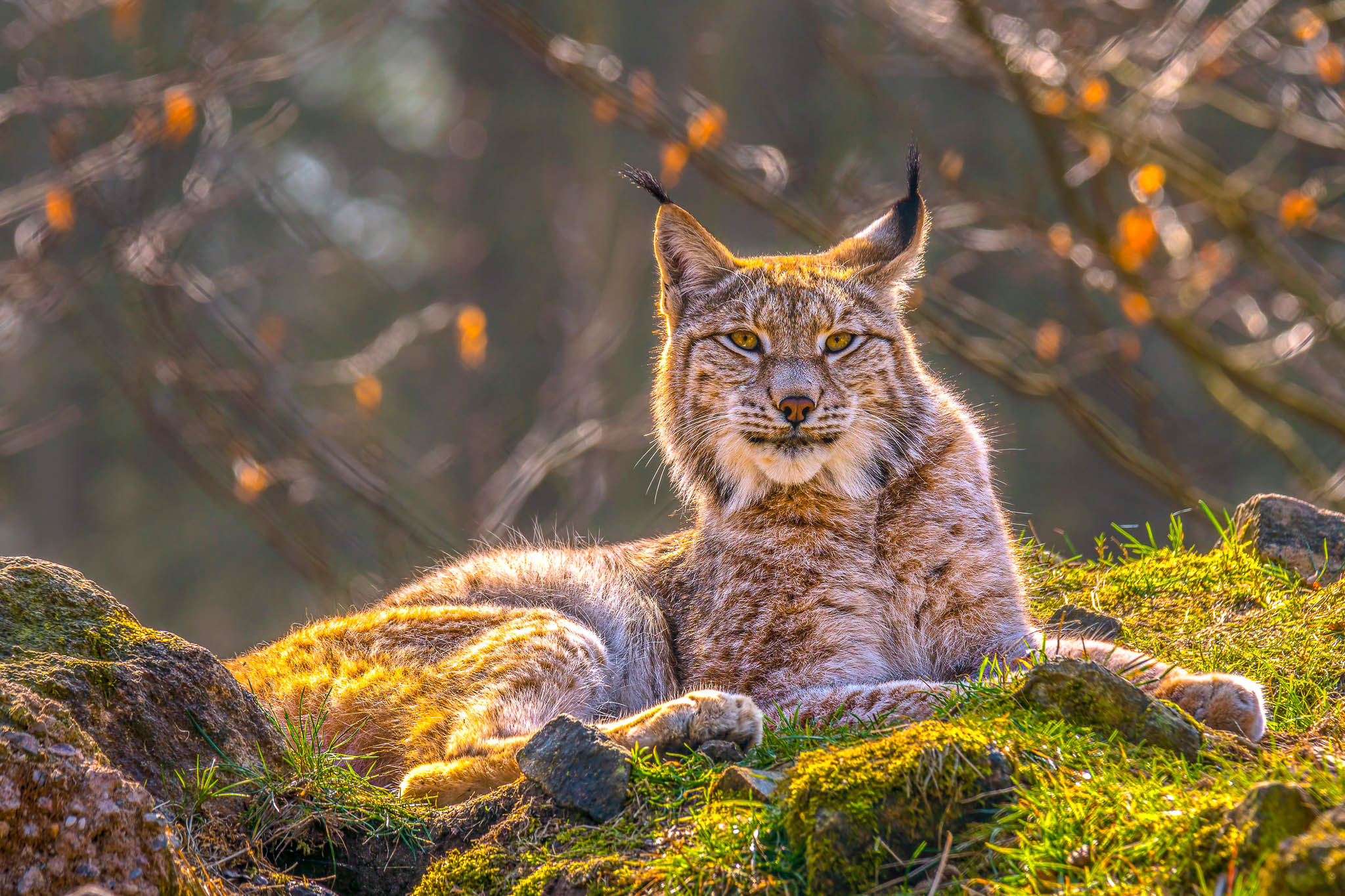
    The Eurasian lynx is the biggest of the four members of the lynx genus, weighing in at up to 35 kg. Those from the North and East of the Eurasian landmass are generally bigger than those from the more fragmented populations in Western Europe. Males are also bigger than females.

    The lynx’s coat is very variable. There are both grey and almost orange lynx. The pale yellow color of other cats is also common. Spots can be large or small or even nearly stripes. Most noticeable though, are the tufts on the ears that are a distinguishing feature (unfortunately, in Western Europe, being wild, big and cat is enough to recognize it). Tails are short and have a black tip.

    Like the Canadian lynx, the Eurasian lynx lives in areas that get a lot of winter snow. As a result, their paws are pretty large and furry, helping them travel better over the snowy ground in winter. Their legs are also relatively long.

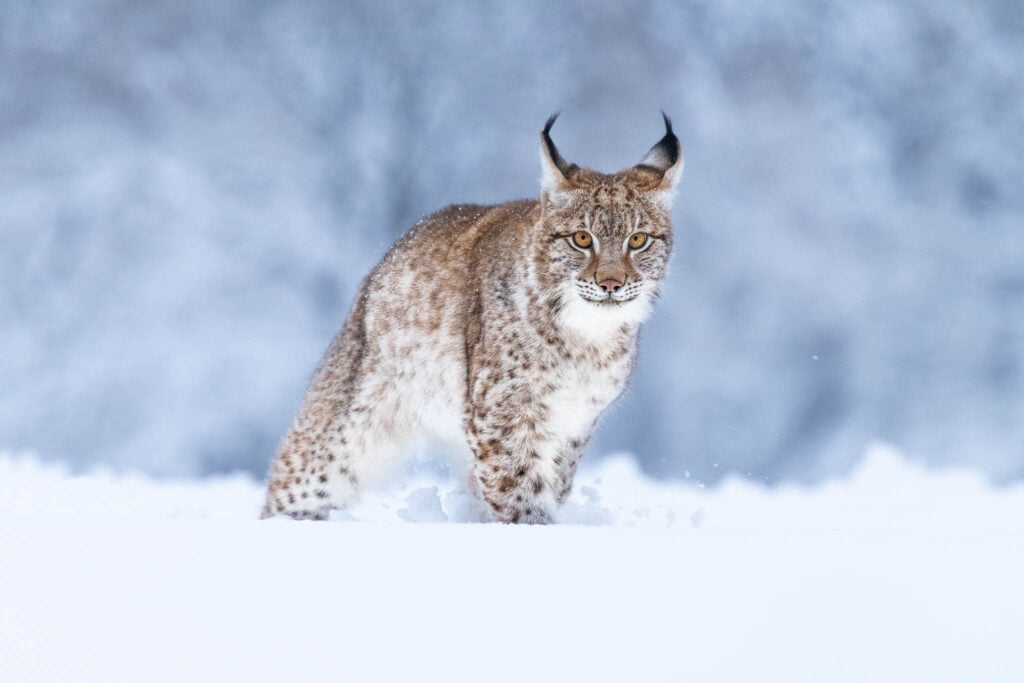
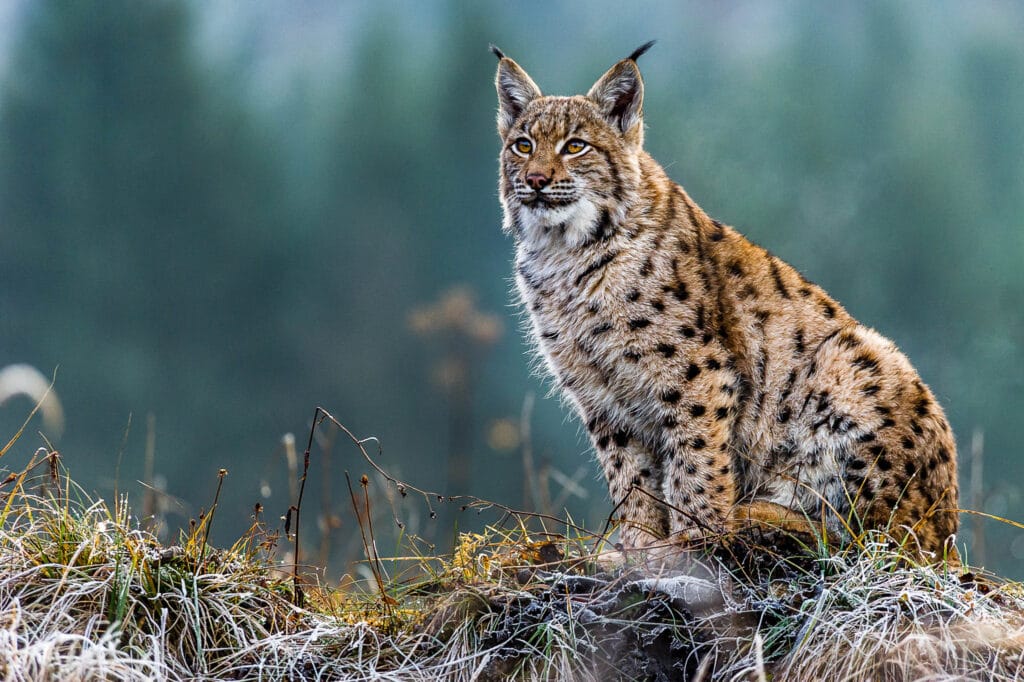
    Young Eurasian lynx (Lynx lynx) in the snow. The dull winter coat helps to hide the beautiful animal in the snowy environment on this cold day. This photographer captured the beautiful amber eyes. What appears like a cute cub is a dangerous and endangered predator.
    Licensed from Shutterstock
    Young Eurasian lynx (Lynx lynx) in the snow. The dull winter coat helps to hide the beautiful animal in the snowy environment on this cold day. This photographer captured the beautiful amber eyes. What appears like a cute cub is a dangerous and endangered predator.

    Distribution and habitat of Eurasian Lynx

    Found across Russia, Central Asia and Europe, the Eurasian Lynx has one of the largest ranges of any cat. Living in mostly forested areas, the lynx is more widespread in the East than in the West, where human development has severely restricted their range.

    The deforestation of much of Western Europe has led to a demise in the historic lynx population here, leaving only patchy populations. Lynx today are much more numerous and have a more extensive range across Northern Europe and Russia.

    Habitat varies across the lynx’s range. What is consistent, is that they prefer forested areas and areas with dense populations of prey (small deer or similar). In the southern area of their range, towards Central Asia and as far south as the Himalayas, forest cover is more limited so lynx live in more open areas. However, they still need places that have at least some trees or woodlands.

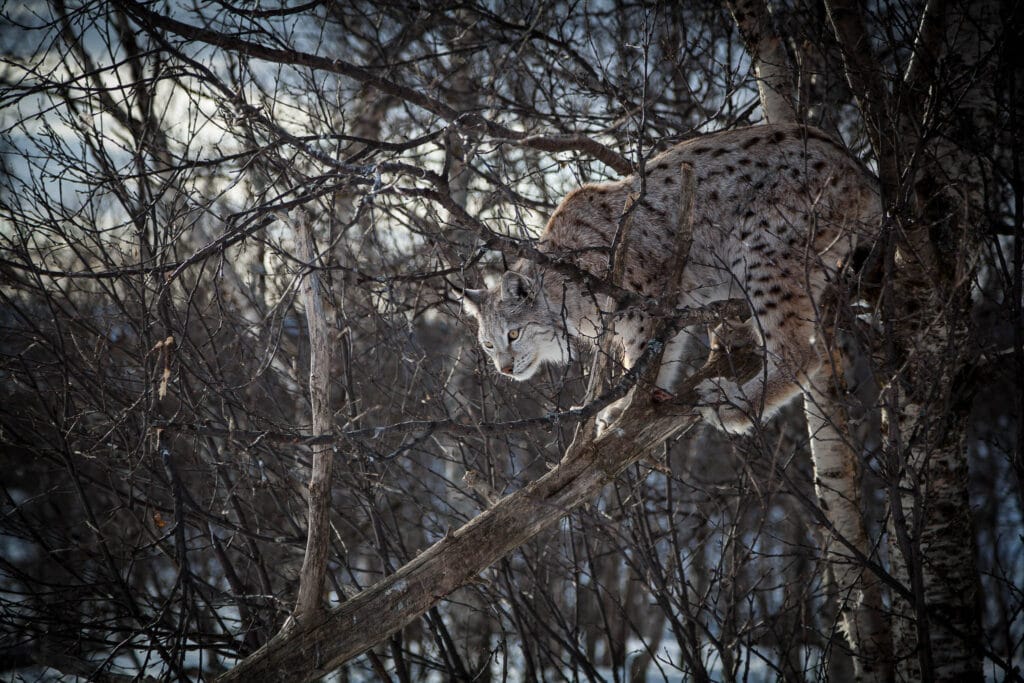
    Most cats like to climb trees. The Eurasian lynx (Lynx lynx) is no exception. The pale grey winter fur offers camouflage in the snow but also against the pale bark of the birch trees common in the boreal forest.
    CC License, image by Tom Bech
    Most cats like to climb trees. The Eurasian lynx (Lynx lynx) is no exception. The pale grey winter fur offers camouflage in the snow but also against the pale bark of the birch trees common in the boreal forest.

    Eurasian Lynx behavior

    The Eurasian lynx is most active during the early morning and late evening, the same time as their prey is active. Normally, they spend the rest of the day being lazy, resting in the bushes, though they are known to be good climbers and can be found in trees as well.

    The range of single cats can be about 200 square kilometers, though males need more space than females. Habitat and prey determine the range, and sometimes this can be even bigger if prey is scarce and forest cover permits more travel.

    The female’s home range depends on the availability to feed her young and is often reduced when she has very young kittens to care for. Sometimes, a female lynx will allow her territory to overlap with that of her daughters. The range of the male lynx can overlap with that of the female as he generally chooses areas that will give him as much mating opportunity as possible.

    Like most cats, the Eurasian lynx marks its territory with urine and other secretions. They have good eyesight and hearing, though it is not well established if this is important for communication. Vocalizations are known but are often very quiet.

    The Eurasian Lynx (Lynx lynx), a medium-sized feline, inhabits expansive forests spanning Siberia, Central, East, and Southern Asia, as well as Eastern, North, and Central Europe. Specialized for forested environments, the lynx's range contrasts with the broader habitats of leopards and pumas, highlighting its remarkable adaptation.
    Licensed from Shutterstock
    The Eurasian Lynx (Lynx lynx), a medium-sized feline, inhabits expansive forests spanning Siberia, Central, East, and Southern Asia, as well as Eastern, North, and Central Europe. Specialized for forested environments, the lynx’s range contrasts with the broader habitats of leopards and pumas, highlighting its remarkable adaptation.

    What do Eurasian Lynx eat?

    Eurasian lynx specialize in preying on smaller ungulates (chamois, roe deer, etc.). Larger animals, such as moose or red deer, can also succumb to the lynx in the difficult conditions of winter. Anywhere where such prey is rare, the Eurasian lynx will prey upon smaller animals, such as hares and birds similar to the other lynx species. Lynx can kill prey up to 4 times their own size, generally by stalking under the cover of the forest and, like most cats, pouncing and grabbing the neck at the last moment, suffocating the prey.

    Prey is regularly dragged off to the deep cover of the forest to be eaten. Larger prey is sometimes cached for later use.

    Wolves and lynx inhabit the same space and are generally friendly towards one another. This is because their prey is usually different, and they can co-occur peacefully. Lynx hunt the smaller deer (roe and fallow deer), while wolves prefer the larger red deer.

    Also, while these prey animals intermingle, they are generally found in slightly different areas, with the red deer out in the open where wolves can hunt more successfully in packs, leaving the lynx to hunt in the tighter areas of the forest for the smaller ungulates. This leads to a peaceful co-existence among the predators.

    The Eurasian lynx (Lynx lynx) is widespread across Europe and Russia. It is secretive and often stays deep in the forest. Sightings are rare, but more common if the cat ventures toward open ground or around the edges of the woods.
    The Eurasian lynx (Lynx lynx) is widespread across Europe and Russia. It is secretive and often stays deep in the forest. Sightings are rare, but more common if the cat ventures toward open ground or around the edges of the woods.

    Mating and Parental care of Eurasian Lynx

    Females and males live, like most cats, separate lives, coming together only to mate. The mating season is generally in the springtime, roughly February to April, and cubs are born about ten weeks later.

    A litter is made up of 2 or 3 kittens who reach independence in a little less than a year. However, as soon as they are able to, the kittens follow the mother as she hunts and learn the necessary skills to provide for themselves.

    Who preys on Eurasian Lynx

    Generally, the Eurasian lynx is at the top of the food chain, though they are known to have been killed by bigger predators such as tigers and wolves, and of course, humans.

    Encountering the elusive Eurasian Lynx (Lynx lynx) up close is a rare opportunity. Winter sightings are relatively more common, facilitated by tracking their prints in the snow. Across its range, the lynx is protected except in Russia.
    Licensed from Shutterstock
    Encountering the elusive Eurasian Lynx (Lynx lynx) up close is a rare opportunity. Winter sightings are relatively more common, facilitated by tracking their prints in the snow. Across its range, the lynx is protected except in Russia.

    How long do Eurasian Lynx live?

    Eurasian lynx are known to have survived more than 15 years in the wild but the survival rates of young lynx are not good.

    Eurasian Lynx and their ecosystem

    The Eurasian lynx plays a vital role in its ecosystem as it is an apex predator. So much so that it is being considered for reintroduction to areas where it has become extinct, such as the UK.

    Lynx are well known for controlling the deer population and, as one of the main predators, are a determinant of the numbers of small ungulates in a region. This influence varies across the range, being dependent on the number of other predators and humans in the area.

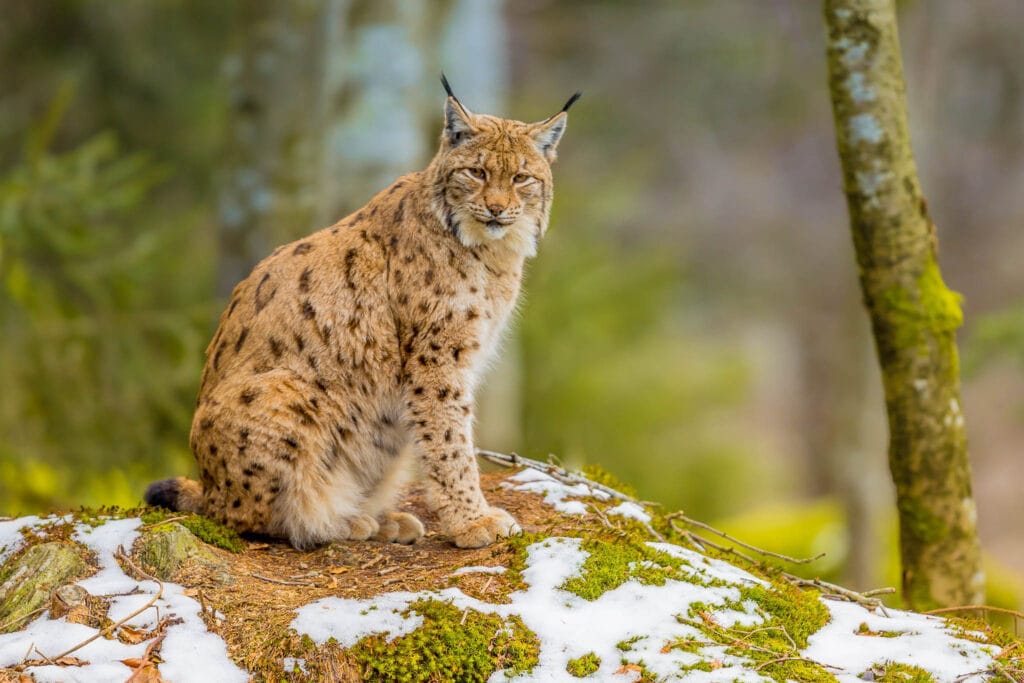
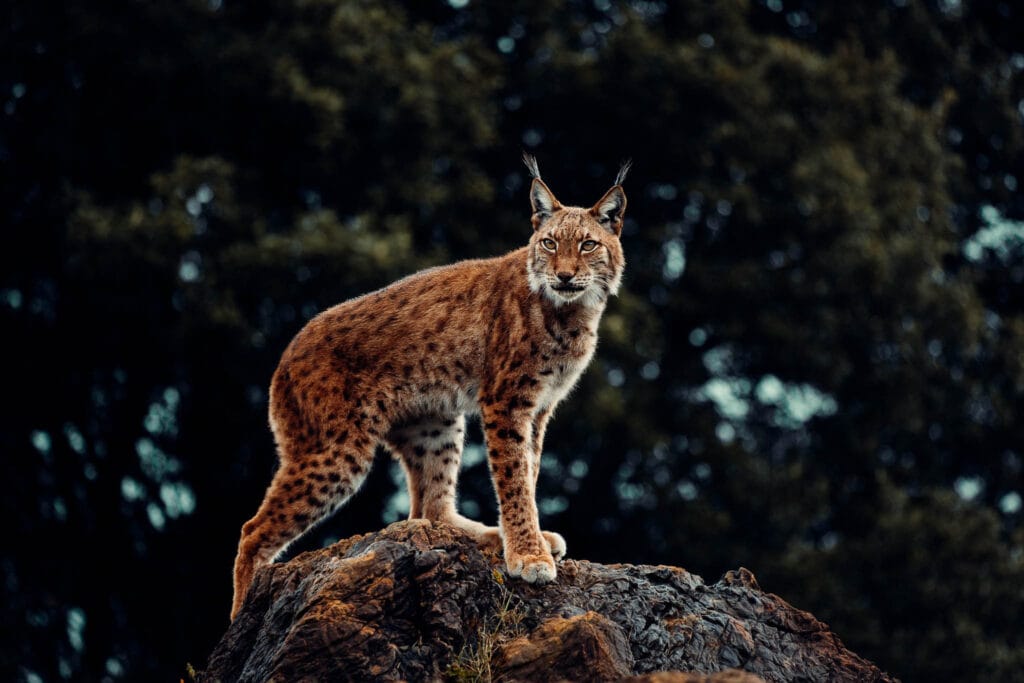
    A beautiful view of a slender Eurasian lynx (Lynx lynx) standing on a rock as a better vantage point.
    Licensed from Shutterstock
    A beautiful view of a slender Eurasian lynx (Lynx lynx) standing on a rock as a better vantage point.

    Impact of Eurasian Lynx on the human economy

    During the early 20th century, the Eurasian lynx was extensively hunted, especially for its fur. Today, hunting is illegal in its whole range except for Russia, a considerable portion of the lynx’s range. As a result, the population was endangered, though it is rebounding today. There are limited numbers in the Alps, but notable increases have occurred in both the population and inhabited areas in recent years.

    Lynx are generally not a threat to humans, though they can attack when trapped or in danger. Attacks on livestock cause the most upset to humans, though this is generally not in large numbers outside of some parts of Scandinavia. Most European countries now tend to compensate farmers for losses as the economic importance of predators to the ecosystem is becoming better known.

    As lynx prey heavily on game animals, hunters are also regularly annoyed by the animal. This is more of an issue in areas where the balance of the ecosystem is less robust than when the deer and lynx populations are in balance.

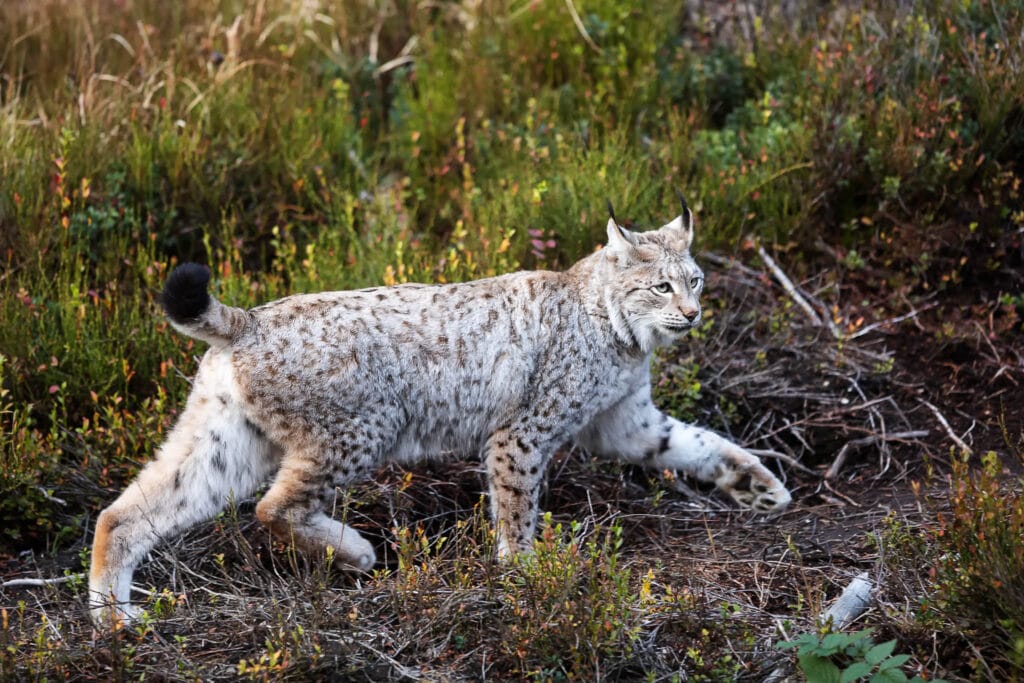
    Eurasian lynx (Lynx lynx) is running in the wild forest. The winter fur can be great camouflage in the snow but might stand out a bit more when there is a lack thereof.
    Licensed from Shutterstock
    Eurasian lynx (Lynx lynx) is running in the wild forest. The winter fur can be great camouflage in the snow but might stand out a bit more when there is a lack thereof.

    Conservation status and human impact on Eurasian Lynx

    As hunting has been outlawed across all countries of the lynx’s range except Russia, the threat from hunting has been reduced. However, deforestation and loss of suitable habitat are still major threats today, across the Eurasian continent.

    Some of the reintroductions of the lynx in the 1970s in Europe have been successful, especially those in France and Switzerland. The one big threat that still exists in Western Europe is the limited habitat. The extensive road and rail networks that must be traversed by lynx lead to fatalities every year.

    The Swiss introduction has been so successful that the population has spread out into western Austria.

    The Eurasian (Lynx lynx) is a specialist, it lives in forests of northern eurasia. Of all the lynxes it tends to hunt the largest prey such as chamois or roe deer.
    Licensed from Shutterstock
    The Eurasian (Lynx lynx) is a specialist, it lives in forests of northern eurasia. Of all the lynxes it tends to hunt the largest prey such as chamois or roe deer.

    Other important information about Eurasian Lynx

    Subspecies:

    Lynx lynx lynx: Scandinavia, eastern Europe, western Siberia.

    Lynx lynx carpathicus: Carpathian Mountains, central Europe.

    Lynx lynx martinoi: the Balkan region.

    Lynx lynx dinniki: the Caucasus mountains

    Lynx lynx wardi: the Altai mountains.

    Lynx lynx wrangeli: eastern Siberia.

    Lynx lynx isabellinus: central Asia.

    Lynx lynx kozlovi: central Siberia.

  • Kodkod

    Kodkod

    Leopardus guigna

    Physical description of Kodkods

    The smallest of the American cats, the kodkod, only weighs a little more than 2 kg and barely reaches half a meter in length. The tail, like a lot of cats, adds about half the body length again. They are pretty good climbers with big feet and relatively long claws.

    The coloring is brown, varying from a more rusty color to a dull, unsaturated grey version. They have dark spots all over, though somewhat less on the lighter-colored underside. The spots sometimes blend together to make an all-black, melanistic fur. The spots on the tail are so close that they look like rings. The tail is also significantly thicker than most cats. Possibly for balance while climbing.

    Distribution and habitat of Kodkods

    The Kodkod, or Guiña, is a native of Chile and also known as the Chilean cat. It has a few names and is sometimes spelt Kod Kod as well. It lives mostly in the south of the country but is also found just across the border in Argentina.

    Being a forest cat, the kodkod lives in the temperate rainforests of the coastal Andes along the fjords of Chile. It is also found in the drier inland and upland coniferous forests as well as in secondary forest areas. More rarely, it can be spotted in regions taken over by agriculture.

    Kodkod behaviour

    The cat’s behavior has been recorded as both nocturnal and diurnal. It is possible that the cat is happy to be active during the day and is only nocturnal due to difficulties surviving in human-impacted habitat. This is known in other species, such as some populations of red deer in Europe.

    What do Kodkods eat?

    Like the similar but slightly larger Geoffroy’s cat, the kodkod is a fan of small rodents.

    Conservation status and human impact on Kodkods

    In the more populated areas of Chile, the population is declining. The kodkod is classified as vulnerable due to habitat loss and deforestation. In some places, hunting still occurs, and dogs are also a threat. Like a lot of cats, the kodkod is somewhat adaptable. The hunting skills transfer between habitats reasonably well. Fragmentation of habitat is still definitely detrimental.

  • Iberian Lynx

    Iberian Lynx

    Physical description of Iberian lynx

    Quite like their cousins, the Eurasian lynx, the Iberian lynx has tufted ears and spotted fur. The spots range from small, blending in with the coat, to large and distinctive. Long legs and short tails are a distinctive feature of the lynx lineage. The Iberian lynx is significantly smaller than the Eurasian lynx, closer to the Canadian lynx in size. The “Beard” is quite distinctive compared to other lynx species.

    Iberian lynx (Lynx pardinus),is  the smallest of the Lynx family, and endemic to the Iberian Peninsula. This image highlights its distinctive 'beard' and tufted ears.
    Licensed from Shutterstock
    Iberian lynx (Lynx pardinus),is the smallest of the Lynx family, and endemic to the Iberian Peninsula. This image highlights its distinctive ‘beard’ and tufted ears.

    Distribution and habitat of Iberian lynx

    Iberian lynx are the only cat endemic to Europe. The Eurasian lynx and European wildcats both stray outside the borders. Lions and tigers used to roam into European lands but haven’t done so for a very long time.

    Isolated from the rest of Europe by the Pyrenean mountains, they once lived across the complete expanse of the Iberian peninsula. Now, however, they are one of the most endangered mammal species that still survive. From the 1960s onwards, their decline was rapid as Spain’s economy developed.

    Since the decline was halted in the 1990s, their numbers have slowly been recovering and now number about 1400 individuals (in early 2024). All surviving Iberian lynx probably live in Spain, as none has been recorded in Portugal since 1992.

    Donaña National Park near Seville has one of the highest concentrations of lynx on the peninsula. The Sierra de Andújar, also in the south, is another stronghold.

    Like a lot of cats, the Iberian lynx is capable of flourishing in terrain that is quite variable. The remaining populations are split between the Mountains of the Sierra Morena, Sierra de Andújar, and the Donaña National Park, which is basically sea level.

    The Mediterranean scrub and farmland are suitable habitats, as are the marshes of Donaña, the delta area of the Guadalquivir River. The open areas provide good hunting grounds for small mammals, including their preferred prey, rabbits.

    One of the issues facing the Iberian lynx is the lack of habitat and, more importantly, transit corridors between the patches of habitat that do exist. Like most cats, they are solitary and need quite a large area.

    Given the lack of travel options, lynx are therefore prevented from exploring, or in other words, forced to live in more dense populations. This, in turn, has a significant effect on genetic exchange.

    Lynx pardinus (Iberian Lynx) nicely blend in with the color of the rocks that cover their range.
    Licensed from Shutterstock
    Lynx pardinus (Iberian Lynx) nicely blend in with the color of the rocks that cover their range.

    Iberian Lynx behaviour

    Iberian lynx are carnivores. They are somewhat nocturnal but are often active at dusk and dawn, as are their prey.

    Adults are generally solitary, living in independent territories. However, the male’s territory often overlaps with that of a female or multiple females. Within these territories, they tend to stick to their separate areas. Territorial conflict is only seen between members of the same sex.

    While these territories would once have been spread out across the Iberian Peninsula, the Iberian lynx lives today in two main populations and a few other isolated smaller populations. Like most cats, it is the male that travels furthest from its place of birth.

    Considering the isolated population structure and limited suitable habitat, this can be a dangerous time for young, year-old lynx. While territorial disputes and lack of food because of the poor habitat are threats, the most significant threats are anthropological until they get a territory established.

    Interestingly, the Iberian lynx is relatively silent. While a lot of cats use vocalizations for communication, the Iberian lynx are generally quiet apart from those within the family group of a mother and her cubs.

    What do Iberian lynx eat?

    Iberian lynx are quick and efficient killers. Unlike larger cats who use a smothering bite to the neck, the lynx uses a strong, single bite to the head of smaller prey (sometimes the neck) that pretty much kills instantly. Their favorite prey is rabbits. The European rabbit is the bulk of their menu. One rabbit a day is about enough to survive, but females often need a lot more when they have young to feed.

    They also prey on the European hare and other small rodents depending on what is available and, if necessary, will go for young deer like their larger cousin, the Eurasian lynx.

    Iberian lynx (Lynx pardinus) after a successful hunt with a rabbit to feed on.
    Licensed from Shutterstock
    Spain wildlife (Iberian lynx) after a successful hunt with a rabbit to feed on.

    Mating and Parental care of Iberian lynx

    Like most cats, males will have a territory that overlaps that of multiple females. However, in the well-protected area of the Donaña NP, the expansion possibilities for young males don’t exist due to the limited area suitable for lynxes.

    Because of this, the population density is much higher, and males are in higher competition with one another. Quite often, males are forced out of the protected areas and have to travel significant distances to find suitable territories. Not all young males are successful in this endeavor.

    Female lynx give birth in dens to very vulnerable kittens. The cubs might need to be moved to new dens for their protection when disturbed. After two months, the cubs are quite active and pretty decent at hunting leaves and their mother’s tail. From this time on, they start to feed on the mother’s kills and leave the den to practice hunting, but it takes a long time to become proficient.

    By eight months, they still spend quite a lot of time with the mother but also hunt independently. When they reach maturity, they leave to establish their own range, but as discussed, this is not easy in areas where there is a lack of connection between suitable habitats.

    Who preys on Iberian lynx

    Apart from the wolf, the Iberian lynx is the largest predator in its ecosystem. As such, it has no predators other than humans.

    How long do Iberian lynx live?

    Lynx can live to 13 years, but a lot die young. Some of the reasons are traffic and illegal hunting. It is, unfortunately, the young that often die in these circumstances as they are trying to establish a territory in unsuitable areas.

    Female Iberian lynx (Lynx pardinus) named Datura standing over a rock watching the valley below, Sierra Morena, Andujar, Andalucia, Spain.
    Licensed from Shutterstock
    Female Iberian lynx (Lynx pardinus) named Datura standing over a rock watching the valley below, Sierra Morena, Andujar, Andalucia, Spain.

    Iberian lynx and their ecosystem

    Due to their dependence on rabbits as their primary source of prey, the Iberian lynx is a very vulnerable species. The balance of the lynx population is very much linked to the balance of the ecosystem providing a ‘correct’ population of rabbits. Their singularity in prey preferences will certainly help keep the population of their prey in check. Iberian lynx might also keep other predators in check by actively killing competitors to increase the rabbits available for their personal consumption.

    Impact of Iberian lynx on the human economy

    Iberian lynx have certainly been persecuted by humans in the past. They were once hunted for their fur. More importantly, though, they were hunted under government orders to increase the opportunities for the small-game industry. This damage to the populations is what led to the lynx’s near extinction.

    Being smaller than the more common Eurasian lynx, the Iberian lynx is not a danger to agriculture or humans. Livestock is not targeted, and they are too small to threaten humans.

    The one threat they could pose is economic. For example, if agricultural lands or forestry lands were forced to have more stringent protections for lynx, it might render them less valuable. It is generally accepted now that more biodiversity will improve such farmland or forestry.

    The Iberian Lynx (Lynx pardinus) used to be one of the most difficult-to-find cats. Due to a recovery program, the number of Iberian lynx is now almost three times what it was 20 years ago.
    CC License, image by Animal Record
    The Iberian Lynx (Lynx pardinus) used to be one of the most difficult-to-find cats. Due to a recovery program, the number of Iberian lynx is now almost three times what it was 20 years ago.

    Conservation status and human impact on Iberian lynx

    The Iberian lynx is extremely endangered. While their numbers have increased since the 1990s, a fragmented population of less than 1500 is very easily disrupted. Most of the damage was inflicted during the industrialization of Spain and the development and growth of the population during the 20th Century.

    While decreasing prey, traffic accidents and hunting have been factors, habitat destruction is the most damaging to their long-term survival. This fragmentation of habitat is one of the biggest killers of young lynx. As males disperse, they, by necessity, go through areas that are unsuitable habitats for them. Crossing roads is a major killer of young lynx, which prevents them from forming stable territories of their own.

    The population is, as of 2024, increasing almost exponentially due to the great conservation efforts of the Andalucians. If only it were this easy to protect and recover all species.

  • Bobcat

    Bobcat

    Physical description of Bobcats

    Bobcats are significantly lighter and half the weight of their northern cousins, the Canadian lynx. Up to a meter long and half a meter at the shoulder they weigh up to 15 kg. The tail is a noticeable 15 cm, which is extremely short for a cat.

    A bobcat (Lynx rufus) stands atop a log, seeking a better vantage point to survey its surroundings.
    Licensed from Shutterstock
    A bobcat (Lynx rufus) stands atop a log, seeking a better vantage point to survey its surroundings.

    Distribution and habitat of Bobcats

    The Bobcat is the more southern of the two lynx family cats in North America. It is found in the southern part of Canada, and throughout the US, downwards to Mexico. The range of the bobcat overlaps that of the Canadian lynx in the North and in the Rockies.

    The bobcat habitat is highly varied. The cat is found across North America. It survives comfortably in most habitats, from forest to brush and arid areas to the high Rockies. The more arid South West US and Mexico have, commensurate with drier regions, a lower population density.

    Best National Parks to see Bobcats

    Bobcats are not easy to see in the wild but a few American National Parks have a decent population.

    Yellowstone and Big Bend National Parks are probably the best to get a sighting.

    Alternately to National Parks, Minnesota is a good spot for bobcats.

    Point Reyes National Seashore in California has regular sightings of bobcats and is easy to access from San Francisco. The State parks of California have quite healthy populations.

    The bobcat’s range overlaps with that of the Canadian Lynx through the Rockies and it is possible but rare to see them in Banff National Park. In Canada the bobcat is more often seen on the British Columbia side of the continental divide.

    The Bobcat (Lynx rufus), known for its climbing prowess like many other cats, often ascends to gain a strategic vantage point for spotting prey.
    Licensed from Shutterstock
    The Bobcat (Lynx rufus), known for its climbing prowess like many other cats, often ascends to gain a strategic vantage point for spotting prey.

    Bobcat behavior

    Activity among bobcats is primarily nocturnal. However, it is possible to see them during the dusk and dawn hours as well.

    Home ranges can be as small as one sq km but are generally larger. Territory is marked by use of urine and scent glands. Males, despite being solitary, tend to have a territory that overlaps that of multiple females. The number of females it shares territory with is somewhat of a success marker for males.

    Being solitary, contact with each other is minimal despite overlapping territories. As such, vocalizations are kept to a minimum with the exception between mother and young, and during mating season.

    Territory marking is applied with scent, and subsequently, the bobcat has an acute sense of smell. Comparative to predator species, their vision and hearing are also well-attuned.

    What do Bobcats eat?

    Bobcats are carnivores. Akin to the similarly small Iberian Lynx, they tend to kill with a single bite to the neck vertebrae, rather than suffocating their prey like larger cats.

    Prey is generally smaller rodents, though birds (easily accessible ones) and reptiles are also targets. When necessary, young deer are considered a good food source.

    In certain circumstances, domestic animals, especially poultry, are also part of a bobcat’s diet.

    Bobcats (Lynx rufus) are often found in California. This one has been successful on a hunt of the California ground squirrel.
    CC License, image by Alan Schmierer
    Bobcats (Lynx rufus) are often found in California. This one has been successful on a hunt of the California ground squirrel.

    Mating and Parental care of Bobcats

    Being a cat expert is relatively easy if you simply learn which species is non-solitary. Bobcats, comparable with others, live alone and only commingle for mating.

    This is typically during spring so that the kittens are born two months later, at the optimal time for the mother to find extra prey. They are nursed for the first six weeks and then fed from the mother’s kills. Remaining with the mother until they have learned to hunt, at about eight months of age, the cubs leave her. Independence brings with it a solitary existence until they mate, in a cycle that repeats itself.

    The Bobcat (Lynx rufus) ranges across North America, enduring harsh winters in certain regions. This image displays a rare mutation, often referred to as a blue bobcat, which gives the fur a blueish-grey tone.
    Licensed from Shutterstock
    The Bobcat (Lynx rufus) ranges across North America, enduring harsh winters in certain regions. This image displays a rare mutation, often referred to as a blue bobcat, which gives the fur a blueish-grey tone.

    Who preys on Bobcats

    Being similar in size with the majority of predators in their ecosystem, bobcats are relatively safe from most creatures, with the exception of humans. Whilst cougars, wolves and bears are larger, the bobcat is not in frequent contact with these larger predators.

    Their kittens, though, are not so safe and need to be protected by their mothers from coyotes and foxes.

    How long do Bobcats live?

    Bobcats’ lifespan is usually 12 years in the wild.

    The bobcat (Lynx rufus), also known as the red lynx, is a medium-sized cat native to North America. It ranges from southern Canada through most of the contiguous United States to Oaxaca in Mexico.
    Licensed from Shutterstock
    The bobcat (Lynx rufus), also known as the red lynx, is a medium-sized cat native to North America. It ranges from southern Canada through most of the contiguous United States to Oaxaca in Mexico.

    Impact of Bobcats on the human economy

    The bobcat was very important to the first explorers of the North American interior. The fur has been used by humans since they arrived in the Americas and was further exploited by the early European settlers.

    They are still extensively hunted for fur. With protection only in a few US and Canadian provinces, the majority still permit hunting and exploitation, and consequently they are probably the most legally-hunted cat species.

    While humans have a significant impact on bobcats, bobcats don’t affect our lives very much. Bobcats rarely attack livestock, but in some suburban areas in the Southeast US, they are increasing in numbers, leading to more domestic pets being killed for food. However, these are relatively rare occurrences in urban spaces.

    Being small, the bobcat is a minimal threat to humans. Although unprovoked attacks have been known, these incidents have been caused by rabid animals, which are not common. Most bobcats will quickly retreat when they encounter humans, and most often before the human is even aware of it.

    However, when they do attack, they can be ferocious, going straight for the jugular. Repercussions of a bobcat attack are infection or rabies rather than serious physical injury.

    Bobcat (Lynx rufus) sits calmly amidst the tranquil forest surroundings, displaying quiet grace and natural beauty.
    Licensed from Shutterstock
    Bobcat (Lynx rufus) sits calmly amidst the tranquil forest surroundings, displaying quiet grace and natural beauty.

    Conservation status and human impact on Bobcats

    There is one subspecies, the Mexican bobcat, Lynx rufus escuinapae, which is also endangered. It lives in Central Mexico.

    The bobcat is one of the two most numerous wild cat species on the planet. There may be up to one million of them living in the US alone. However, the distribution isn’t evenly spread, as they are more commonly found in some areas than others.

  • Jungle Cat

    Jungle Cat

    Physical description of Jungle Cats

    As one of the larger Felis species, the jungle cat can be up to 120 cm long and 40 cm tall. There is a difference in sizes across the range. In areas with fewer predators, jungle cats tend to be larger than those found in areas such as India, where Leopards, Tigers and Dholes out-compete them.

    Jungle cat kittens are born with stripes and spots, though these disappear as they grow up. An adult is generally reddish to light brown and sometimes a bit greyer. The stripes and spots of youth remain only on the legs and the tail. In India, some black individuals have also been spotted. Faces also have some markings and are a bit paler than the rest of the fur. Often, the eyes have a white outline and a darker area below.

    It should be noted that there are significant differences within the species across its range, and there are ten different subspecies.

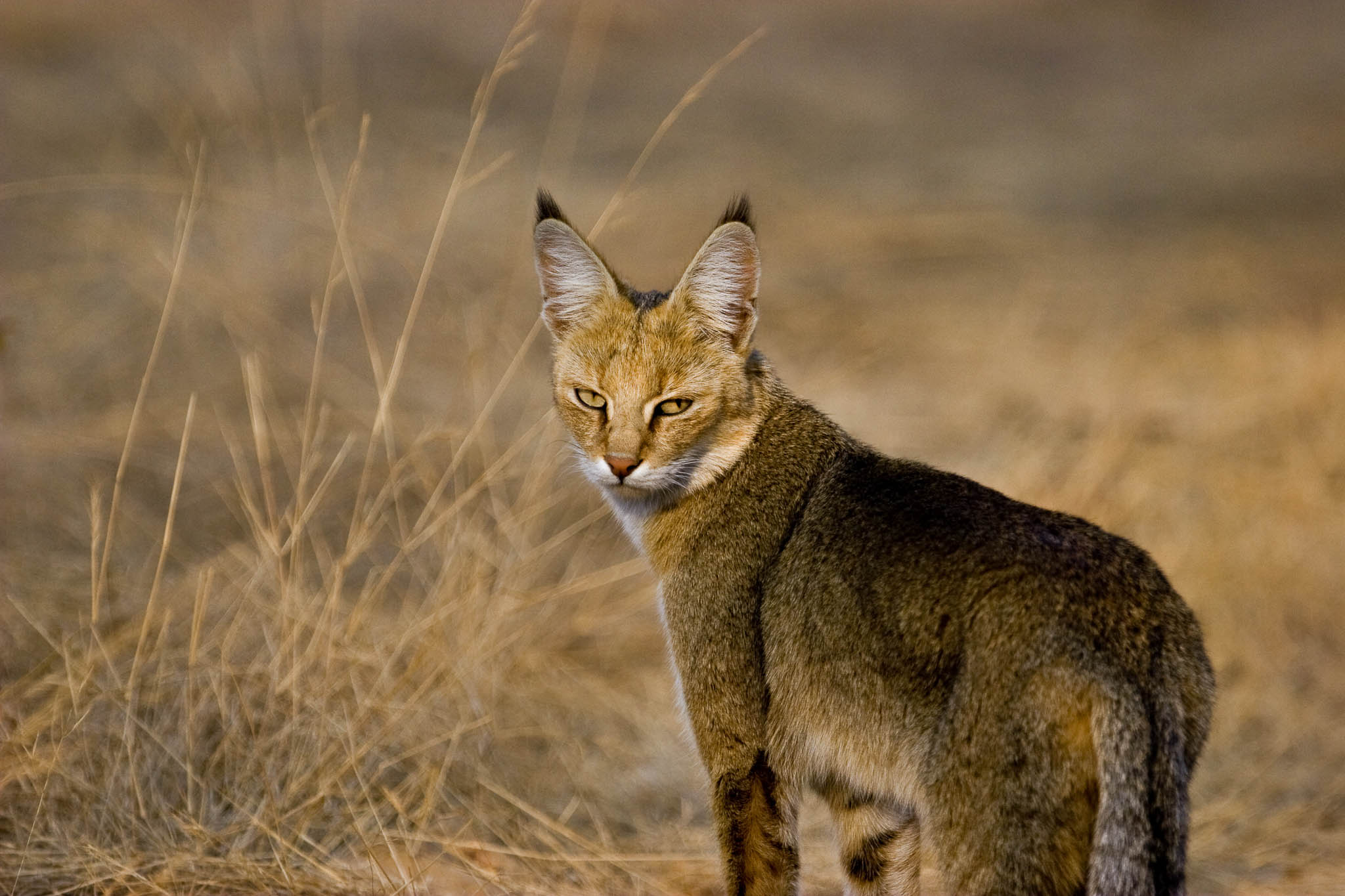
    A vigilant female Jungle Cat (Felis chaus) alertly scanning the surroundings with keen eyes in search of potential prey.
    Licensed from Shutterstock
    A vigilant female Jungle Cat (Felis chaus) alertly scanning the surroundings with keen eyes in search of potential prey.

    Distribution and habitat of Jungle Cats

    The Jungle Cat ranges from Egypt across Asia and is even found in the southern reaches of European Russia. It lives from the jungles of Southeast Asia to the deserts of Central Asia and, despite its name, is often found in areas with no jungle at all.

    Their preferred habitat is somewhere with water. Rivers and their surroundings might be the most obvious places to meet them, but their preference to live and hunt near water means they also can be found in and around oases in the desert as well as in the dense jungle. However, the jungle cat prefers less dense vegetation, such as woodland or dry deciduous forests and even agricultural lands.

    In this endearing scene, a Jungle Cat (Felis chaus) kitten peeking timidly across a dead tree.
    Licensed from Shutterstock
    In this endearing scene, a Jungle Cat (Felis chaus) kitten peeking timidly across a dead tree.

    Jungle Cat behavior

    Despite the parental care being more noticeable than in other cat species, jungle cats are still classed as solitary. We only see them as pairs when mating, or in the family group of a mother with her young.

    Like a lot of life in the jungle, these cats are nocturnal. That does not necessarily mean they are inactive during the day. Jungle cats are sometimes out and about in daylight hours, but more often than not, they hide in the dense jungle.

    One interesting behavior that makes them stand out compared to other cat species is their willingness to get wet. Jungle cats are good fishers and do so from the water rather than from the edge, like some other cat species.

    Vocalization is common among jungle cats within the family group. Scent marking is also commonly done with both urine and cheek rubbing.

    What do Jungle Cats eat?

    The preferred prey of the jungle cat is small. As mentioned it is a good fisher but, just like other cats, also eats rodents and other small mammals as well as reptiles and birds.

    While cats are carnivorous, the jungle cat, like its American jungle cousins, has been known to eat fruit on occasion. However, this is a minor part of the diet, and small mammals are by and large the preference.

    Jungle Cat (Felis chaus) with a fresh kill, a wild rabbit, showing the hunting prowess of this skilled predator in its natural habitat.
    Licensed from Shutterstock
    Jungle Cat (Felis chaus) with a fresh kill, a wild rabbit, showing the hunting prowess of this skilled predator in its natural habitat.

    Mating and Parental care of Jungle Cats

    The reproductive cycle of the jungle cat isn’t too surprising. The one noticeable difference to other cats is that the father does appear to provide some sort of care for kittens.

    While in most cat species, it is the mother that rears kittens alone, it does seem that the male jungle cat patrols its territory with more zeal when kittens are around to prevent other males from killing the kittens.

    There are about three kittens per litter, sometimes more. Mothers care for the kittens for nine months, the first six weeks nursing them, then bringing them back kills, and from about three months on, they are fully weaned, though they stay with the mother another 5 to 6 months to learn to hunt.

    While most cats leave the mother at sexual maturity, the jungle cat leaves earlier and lives independently for a while before reaching full maturity.

    Jungle Cat (Felis chaus) mother tenderly carries her precious cub to a secure den.
    Licensed from Shutterstock
    Jungle Cat (Felis chaus) mother tenderly carries her precious cub to a secure den.

    Who are the Jungle Cat Predators?

    Jungle cats also hunt livestock, and that makes them a target for farmers. In their native habitat, the jungle, they don’t have any other predators unless they live in an area with leopards or tigers.

    Smaller predators like dholes or jackals will also prey on the jungle cat from time to time. Their habitats do overlap a bit but in general they stay away from each other. The dogs are more likely to prey on a small or young cat.

    How long do Jungle Cats live?

    It is thought that the jungle cat lives for about 12 years in the wild.

    Jungle Cats and their ecosystem

    It is hard to say what effect the jungle cat has on its environment other than keeping the smaller animals in check.

    Impact of Jungle Cats on the human economy

    As the jungle cat is not hunted for its pelt, it offers little or no direct economic benefit to humans.

    The jungle cat is known to prey on small livestock in areas of high human populations. This is obviously annoying for the local farmers and, in a lot of places, has a significant economic effect on poor jungle communities.

    Jungle cat (Felis Chaus), rare melanistic form. Nearly all cat species display melanism in some form.
    Licensed from Shutterstock
    Jungle cat (Felis Chaus), rare melanistic form. Nearly all cat species display melanism in some form.

    Conservation status and human impact on Jungle Cats

    Hunting and persecution for livestock deaths is a threat to the jungle cat. However, habitat destruction is, as ever, the biggest threat to this species.

    The IUCN lists the jungle cat as “Least Concern,” but the living cats are illegally traded as pets and hunted for killing livestock, and due to the destruction of their habitat, they are declining in number.

    Other important information about Jungle Cats

    Felis chaus nilotica (Nile Region)
    Felis chaus chaus (Southern Russia)
    Felis chaus furax (Middle East)
    Felis chaus oxiana (Central Asia (Northern Afghanistan))
    Felis chaus prateri (Thar desert)
    Felis chaus affinis (Himalayas)
    Felis chaus kutas (India)
    Felis chaus valballala (India)
    Felis chaus kelaarti (Sri Lanka)
    Felis chaus fulvidina (Southeast Asia)

  • Clouded Leopard

    Clouded Leopard

    Physical description of Clouded Leopards

    The clouded leopard is considered to be one of the big cats although it is not part of the Panthera lineage. Larger individuals are 1 meter long, and half a meter in height. The tail is nearly as long as the body and assists balance for climbing.

    Short legs (relative to other big cats) and flexible ankles help propel them up trees. The body form led early researchers to believe that most of their time was spent in trees, however in recent studies, it appears that the opposite is true. Females are slightly smaller than males.

    The clouded leopard bears distinctive markings. The fur is tinged beige to yellow to grey with large black spots, which are not a uniform shade. Each spot comprises an outline of a large dark patch containing their standard color blended with darker fur. This is the ‘clouded’ effect.

    Facial features are distinguished by black spots with white markings. The spots on the limbs and tail are almost entirely dark whilst the underside is lighter than the rest of their fur.

    A Clouded Leopard (Neofelis Nebulosa) displaying the cloudy patches on its fur. (captive animal)
    Licensed from Shutterstock
    A Clouded Leopard (Neofelis Nebulosa) displaying the cloudy patches on its fur. (captive animal)

    Distribution and habitat of Clouded Leopards

    From the Himalayas of Nepal through to Southeast Asia, the elusive Clouded Leopard lives in the jungles and mountains, and is notoriously difficult to find.

    In the seclusion of forest depths and rugged mountain terrains, these mysterious cats evade human interaction and are shielded from keen observation. They are tree climbers, but predominantly ground-dwelling and ground-hunting cats.

    Clouded leopards live in the forest biomes throughout Southeast Asia and into China, however, they are ideally suited for the tropical jungle. Though less common, they have occasionally been spotted in grassland areas.

    Clouded Leopard behaviour

    The behavior of clouded leopards is relatively unknown. As active climbers, it was initially thought that they were more arboreal. However, recent discoveries suggest that ground-based hunting and living is prevalent, though they rest in trees.

    This survival skill protects them from larger predators such as tigers, though tigers have been severely reduced in much of its range. Their agile body is well adapted for trees, with flexible ankles which enable a griphold of curved branches and trunks.

    Active both during the day and night, it is difficult to ascertain their preference. Nocturnal activity is currently perceived to be a trait.

    Although little is known of how they interact with each other, it is interesting to note that the ranges of males and females are similar. In the majority of cat species, the male habitually has a greater range that overlaps the territories of multiple females. However, radio-tracking data disproves this behavior in clouded leopards. Modern technology, such as GPS and camera traps, will soon provide us with definitive evidence.

    Communication is via markings and vocalizations. It is evident that they communicate with each other in captivity. Since few encounters in the wild have been recorded, it isn’t straightforward to determine what is standard. Claw marks and spraying are, akin with other cats, used to mark territories.

    Clouded Leopard (Neofelis Nebulosa) exploring the jungle
    CC License, image by Richard
    Clouded Leopard (Neofelis Nebulosa) exploring the jungle

    What do Clouded Leopards eat?

    Clouded leopards prey on a wide range of species. Being somewhat arboreal, they hunt birds and monkeys more than other cats. Muntjac and sambar deer species are on the larger side of their prey, but more commonly, they hunt smaller deer and wild boar.

    Prey is usually dispatched with a single bite to the back of the head. Clouded leopards will occasionally feed on domestic livestock.

    Mating and Parental care of Clouded Leopards

    Observing the mating behavior of these elusive jungle cats in their native habitat has been scant. Contemporary research knowledge is evidently limited to captive breeding programs, most notably, the young are born with fully formed dark spots. The clouded effect is apparent from six months. As they mature, the cubs become active, and after a couple of months begin to climb trees.

    After a three to four month gestation period, up to five cubs are born in each litter. During the first eight to ten weeks, the cubs are nursed, then weaned onto prey that the mother catches. Whilst they may be capable of hunting for themselves from this time onwards, the cubs remain with the mother for almost ten months to hone their hunting skills for self-sufficiency and independence.

    Who preys on Clouded Leopards

    Humans are the largest threat to clouded leopards, which are hunted for their fur. Ceaseless habitat destruction began at the advent of the 21st century, and is a major contemporary threat.

    Tigers and leopards would ordinarily be potential predators, but the larger cats’ populations have been decimated, so that they do not pose a significant threat anymore. Considered a reasonably large predator themselves, the clouded leopard isn’t threatened by many terrestrial mammals.

    Impact of Clouded Leopards on the human economy

    Unfortunately, clouded leopard pelts are exploited and illegally traded in the two main regions of Taiwan and China.

    There is also rampant demand for the use of their body parts in traditional medicines, despite such remedies having been proved to be ineffective. The cats are also captured and traded as exotic pets.

    The clouded leopard is large enough to prey on livestock. While full-grown cattle are a sizable challenge, calves, pigs, sheep and goats are relatively easy targets. The destruction of the cats’ habitat as a consequence of over-population, has led to increased human-cat conflict.

    Clouded Leopard (Neofelis nebulosa) prowls with graceful stealth, showcasing the natural predatory behavior of this mesmerizing feline, even in captivity.
    Licensed from Shutterstock
    Clouded Leopard (Neofelis nebulosa) prowls with graceful stealth, showcasing the natural predatory behavior of this mesmerizing feline, even in captivity.

    Conservation status and human impact on Clouded Leopards

    The IUCN states that the clouded leopard is vulnerable, and trade has been restricted by CITES since 1975. This has done little to protect them from the threat of rapid deforestation and growing human populations.

    With the exception of Laos, hunting has been banned throughout the range of the clouded leopard. This, and the prohibition of owning exotic pets has had minor effect due to the lack of proper enforcement. Extensive poaching and hunting by farmers continues to endanger dwindling numbers.

    National parks have been created to help protect the cat, but the elusive nature of this dense jungle-dwelling creature further complicates an accurate headcount. Even more so, it is challenging to discern whether conservation efforts are having a positive impact.

    Other important information about Clouded Leopards

    The subspecies Neofelis nebulosa brachyura from Taiwan is probably extinct.

  • Mountain Lion

    Mountain Lion

    Physical description of Mountain Lions

    The mountain lion is a relatively big cat with body lengths of up to one and a half meters in males. The female is about 10 % smaller. The tail adds almost another meter to some of the bigger animals.

    It is not as bulky as other cats this size, being more closely related to the cheetah than to the lion. However, the legs resemble the latter a bit more, being quite strong and muscular compared to the cheetah’s lithe limbs made for running.

    Its short fur is rather rough and varies from light golden brown to a more muddy grey color. On its belly, it is a bit lighter and often has a white chest. The pink nose is distinctive, but the rest of the facial markings are relatively subtle.

    The broad, flat head marks the mountain lion as easily recognizable among cats.

    An endangered Florida Panther (Puma concolor) darting through the forerst.
    Licensed from Shutterstock
    An endangered Florida Panther (Puma concolor) darting through the forerst.

    Distribution and habitat of Mountain Lions

    While the range of Pumas used to be much more widespread, today their population is more limited. They still range across most of the Americas, but their populations are much more restricted, especially in the USA.

    The eastern US now only has a limited population in Florida. Numbers are higher in the west, and sometimes pumas are to be found in suburban areas such as in California.

    Further south, they are found in most habitats, but the most visible are those of Patagonia. The cougar does live in the tropical jungle as well but is seen much more rarely, given the dense cover.

    The cougar lives in a multitude of habitats, from arid grasslands to dense jungles and from tropical to mountain forests. It uses anything from thick brush to caves for cover and shelter

    Best National Parks to see Mountain Lions

    If you are visiting National Parks like Banff, Yellowstone you might get a chance to see Mountain Lions. Also the State Parks of souther California have a population that is more visible than in some other places.

    Mountain Lion behaviour

    Other than mothers with their young, mountain lions are solitary cats. Yes, most cats are. The only time males and females tend to spend time together, other than random meetings in overlapping territories, is when they are mating. This can last up to a week but is generally just a couple of days.

    Being such large and predatory animals, they have quite a range. Depending on the amount of prey available, mountain lions need up to 300 sq km per animal. The range of males is quite a bit more than the females that share his territory.

    Sometimes, young males are found together like cheetahs, but unlike their close cousins, this does not last into adulthood.

    Mountain lions are communicative, especially between the young and their mother. Depending on the circumstances, these cats have a large vocabulary of growls and purrs. However, the young seem to whistle when calling to their mother.

    Like other cats, scent is also an important communication tool, used for marking territory and letting the opposite sex know you are interested.

    A beautiful Puma (Puma Concolor) cub exploring on rocks in the forest.
    Licensed from Shutterstock
    A beautiful Puma (Puma Concolor) cub exploring on rocks in the forest.

    What do Mountain Lions eat?

    This should be no surprise to anybody: Mountain lions, like most cats, are strict carnivores. They will eat any prey they can find but tend to look for larger kills when possible. That means any bigger deer like elk in the North and Guanaco in the southern portion of their range. Moose and caribou are also on the menu, as are livestock animals. However, they hunt livestock a lot less than they are given credit for, as there is a risk in being around human habitation.

    A mountain lion needs more than one large animal a week and so supplements its diet with smaller animals like rabbits, raccoons, opossums, squirrels, and at times even birds and fish when they can get hold of them. As one animal the size of an elk can last so long, mountain lions often hide them, covering them with brush and returning on subsequent nights to feed.

    Mating and Parental care of Mountain Lions

    Separate mountain lion territories are important. The very young are kept in dens in protected areas by the mother. These areas need to have enough prey nearby to support a nursing mother and her brood.

    Females keep separate territories and generally don’t start breeding until such territories have been properly established. Males often have territories that overlap with female mountain lions, and males sometimes pose a danger to cubs.

    Mating can occur at any time but generally in the winter months, leading to birth three months later. Females reproduce typically every two years and give birth to 3 or 4 cubs. Cubs are already active within the first two weeks and are weaned after about six weeks.

    Like most cats, they stay with their mothers a lot longer as they need to learn to hunt. Generally, families are together for just over a year, but it can be longer. It takes 2 to 3 years before cats will establish a breeding territory.

    An attentive Cougar (Puma concolor) mother tenderly cares for her adorable cubs, one of which is seen suckling, illustrating the nurturing bond and maternal instincts.
    Licensed from Shutterstock
    An attentive Cougar (Puma concolor) mother tenderly cares for her adorable cubs, one of which is seen suckling, illustrating the nurturing bond and maternal instincts.

    Who preys on Mountain Lions

    The biggest threat to a mountain lion is man. However, their small stature does leave them vulnerable to wolves or bears who are desperate for a meal. Even larger mountain lions will sometimes see a smaller one as potential prey.

    How long do Mountain Lions live?

    The expected lifespan of a mountain lion is about 20 years.

    Licensed from Shutterstock

    Mountain Lions and their ecosystem

    In a lot of the areas inhabited by mountain lions, populations of other top predators have been decimated by human interference. That means that now they are an important method of control for the grazing population.

    A family of wild Cougars (Puma concolor) in Torres del Paine National Park, Chile. Three nearly fully grown cubs wait by the river's edge for their mother's return, their hunting skills not yet matured enough for independence.
    Licensed from Shutterstock
    A family of wild Cougars (Puma concolor) in Torres del Paine National Park, Chile. Three nearly fully grown cubs wait by the river’s edge for their mother’s return, their hunting skills not yet matured enough for independence.

    Impact of Mountain Lions on the human economy

    Unfortunately, nowadays mountain lions are still hunted. They are persecuted by farmers, sometimes for good reason but often not, and also hunted for sport in the US.

    Despite their position in US culture as dangerous predators of hikers, there is, on average, only one fatal attack every five years. Given the circumstances of most attacks, it is thought that the mountain lion mistakes humans for prey, and quite often, it is a case of uninformed hikers letting younger and smaller members of their party separate from the group at prime hunting time (evening).

    In the vast majority of encounters, mountain lions retreat instantly. Knowing the behavior of mountain lions significantly decreases the risks.

    Puma (Puma concolor), also commonly known as the mountain lion or cougar, is the only cat whose habitat covers most of the Americas. It lives from the forests of the Rockies through the tropical rainforest all the way to the mountains of Patagonia.
    Licensed from Shutterstock
    Puma (Puma concolor), also commonly known as the mountain lion or cougar, is the only cat whose habitat covers most of the Americas. It lives from the forests of the Rockies through the tropical rainforest all the way to the mountains of Patagonia.

    Conservation status and human impact on Mountain Lions

    The Wisconsin subspecies is considered to be extinct, though it is still listed as endangered. The Florida and Costa Rican subspecies are believed to still be with us, though both are severely endangered.

  • Rusty-Spotted Cat

    Rusty-Spotted Cat

    Physical description of Rusty-spotted Cats

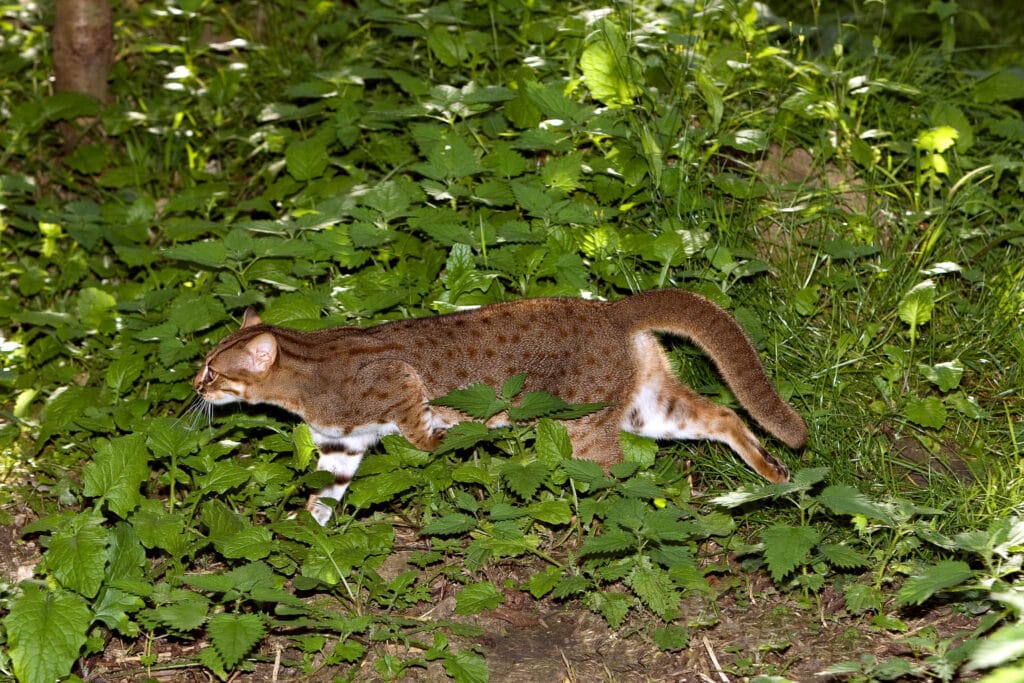
    Guess what? The rusty-spotted cat isn’t rusty colored. It is more of a grey (and in some areas, yes it is more reddish brown), but it is spotted, and it is these spots that are generally a rusty brown color. So it isn’t a rusty spotted-cat but a rusty-spotted cat. Hyphenation is important to cats. There is also some striping on the shoulders and head, somewhat darker than the spots.

    This is the smallest of the cats, only about 1.5 kg in weight. Males are a little heavier, females a little smaller. Domestic cats are about twice the size. The tail is also relatively short, only about half the total body length.

    Rusty-spotted Cat: Habitat and Distribution

    Rusty-spotted cats are found in South Asia, mostly in India and Sri Lanka. They range from the North of India, near Nepal, through central India to the rainforests of the Western Ghats. They live in the dry and tropical forests of India and are pretty much everywhere except the desert northwest and the mountainous north.

    The rusty-spotted cat’s habitat is generally drier forest, but this is not its exclusive habitat anymore. The cat is now known to live in human habitats as well, mostly in farmland and agricultural land, though it is more often found in the drier forests. While forest cover might be a defining characteristic of their habitat, given that they live in both tropical and drier deciduous forest, the rusty-spotted cat also has been found in less forested areas.

    Rusty-spotted Cat behavior

    Like almost all other cat species, independence brings solitary living. Given that the range of the male is a bit larger, it probably overlaps that of nearby females, but they haven’t been regularly sighted together except during mating periods. However, mother and kittens do stay together. Rusty-spotted cats are active all the time but probably more so during the nighttime. Most sightings occur during dawn and dusk.

    Scent and spray marking. Not much else is known.

    What do Rusty-spotted Cats eat?

    Reliable evidence on the complete diet is hard to come by. It is observed that some rusty-spotted cats eat birds and mammals, small ones, as it is a small cat. It is possible that they are not strict carnivores like most cats. Research in zoos has shown that they eat fruits, but that does not guarantee they do the same in the wild.

    The Rusty-Spotted Cat (Prionailurus rubiginosus) gracefully moves through lush foliage, offering a rare glimpse into the secretive world of this diminutive wild cat species.
    Licensed from Shutterstock
    The Rusty-Spotted Cat (Prionailurus rubiginosus) gracefully moves through lush foliage, offering a rare glimpse into the secretive world of this diminutive wild cat species.

    Mating and Parental care of Rusty-spotted Cats

    Given a lack of clear information, we have to assume that the rusty-spotted cat reproduces in the same ways as similar species in the Prionailurs genus, such as the leopard cat.

    The idea that they are similar hasn’t been disproven, though the amount of research on the rusty-spotted cat in the wild is limited. Some things were observed in zoos, but that doesn’t mean that everything we were able to learn applies in the wild as well.

    It is possible that the cats are polygynous, meaning that the male has territories that overlap that of females and mates with multiple. This would be in line with the similar leopard cats from the same family, Prionailurus.

    Gestation lasts for a bit more than two months, and kittens are born in some sort of den, like hollow trees or similarly protected areas. In five to six weeks the kittens are weaned and are ready for the world. They are very active from about four weeks on. Like all cats, weaning isn’t instant independence. There is a lot of time devoted to learning to hunt by copying the mother. True independence probably comes around nine months.

    Rusty-spotted Cats and their ecosystem

    They probably control their prey species. They might prey on a specific small mammal more often and prevent it from getting out of control. We cannot be sure. They could also be of no use to the ecosystem, but experience tells us otherwise. Every little link is vital.

    Conservation status and human impact on Rusty-spotted Cats

    Habitat loss is the main problem facing rusty-spotted cats, leading to a reduced population. At the moment, the IUCN red list status is near threatened. This could change as the population declines. Increasing agriculture is the leading cause of habitat loss.

    Other important information about Rusty-spotted Cats

    Prionailurus rubiginosus phillipsi is the Sri Lankan subspecies.

Subscribe To Our Newsletter

Join my mailing list to keep up to date with wildlife news.

You have Successfully Subscribed!

Pin It on Pinterest

Cookie Consent with Real Cookie Banner