Leopardus wiedii

Quick Facts

Status: Near Threatened
Young: have 2 kittens on aveage
Weight: 3-4 kg
Diet: Carnivore

Physical description of Margays

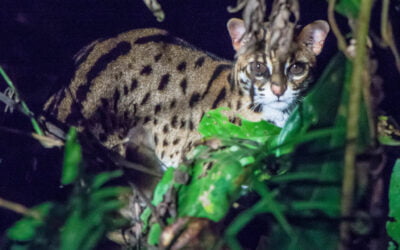
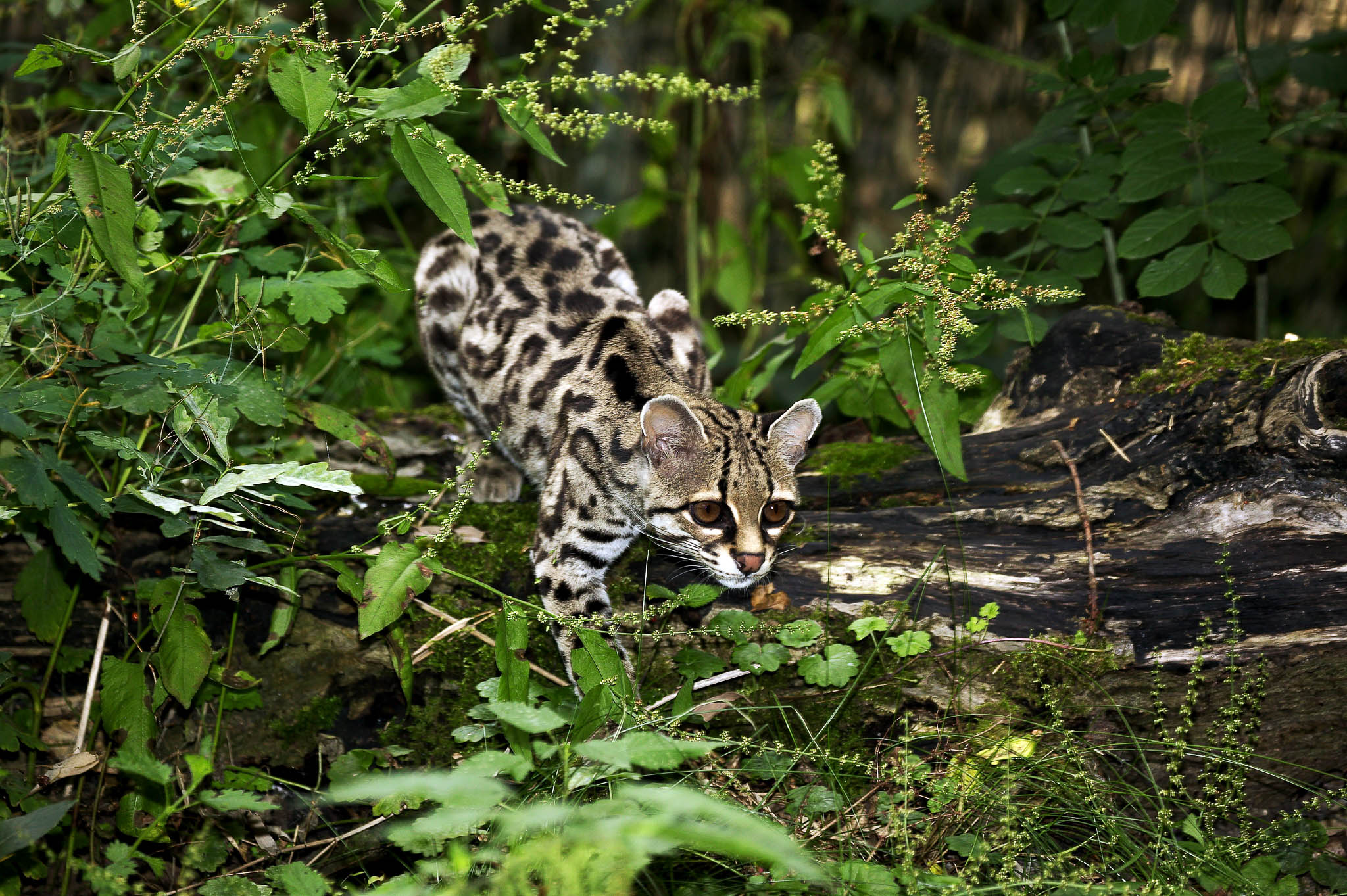
Margays are small cats. Spotted and looking quite like the ocelot, they are hard to tell apart. In fact, in German, they are called the Baumozelot, which literally translates to the tree ocelot. Their spots are generally in rows along the body, and their fur is tan or sometimes reddish brown. The stomach is white. Despite living in the warm forests of the tropics, the margay’s fur is quite thick.

Distribution and habitat of Margays

The Margay is found in the Americas, from Argentina through to Mexico, from the subtropical forests of the north of Argentina through the jungles of the Amazon and Central America.

Margays are almost exclusively found in forests. Both tropical and subtropical.

The Margay (Leopardus wiedii) roams the jungles of the Americas, with this one captured on camera in Belize.
Licensed from Shutterstock
The Margay (Leopardus wiedii) roams the jungles of the Americas, with this one captured on camera in Belize.

Margay behaviour

The distinctive feature of the margay is its ability to climb trees. While all cats are capable of climbing, there is a very meaningful line in the Winnie the Pooh books: “Tigger never said Tiggers know how to get down again.” This certainly does not apply to margays, who are capable of walking down trees facing forward due to a very flexible ankle. In fact, their rear feet can turn 180 degrees, allowing them to grip trunks and making them the most agile of the cat family when high up in trees.

It seems that margays are equally active during the day and night, but again, it is hard to tell when they are so difficult to find in the deep jungle. They are asocial and only hang out during breeding season. Once more, it is difficult to be sure that this is always the case.

What do Margays eat?

Margays eat almost anything, including small mammals, birds and their eggs, and pretty much anything else that comes available.

Mating and Parental care of Margays

Unfortunately, this forest dweller is pretty difficult to study in the wild as the margay remains well hidden in its forests. Because of this, a lot is unknown. It seems that margays breed once a year and have a litter of one or two kittens.

A caring Margay (Leopardus wiedii) mother carries her precious cub to a new, secure den, making sure the littel one is safe.
Licensed from Shutterstock
A caring Margay (Leopardus wiedii) mother carries her precious cub to a new, secure den, making sure the littel one is safe.

Impact of Margays on the human economy

Margays don’t have any economic importance to humans apart from their role in the ecosystem.

There are no negatives to humans in having margays around, but they might prey on small livestock or poultry.

Conservation status and human impact on Margays

Margays are rare everywhere. Considering lots were killed for fur in the past, and ongoing deforestation causing habitat loss, they are endangered. Most hunting is now limited within their range, but deforestation still occurs.

Other important information about Margays

The margay has multiple local names throughout its extensive range.

If your friends are animals lovers, share this page with them

Margay in French, German, Spanish ...

Latin Name
Leopardus wiedii
Alternative Names
Tree Ocelot
French Names
Margay, Chat Tigre
German Names
Margay, Baumozelot
Spanish Names
Margay, Caucel, Gato Montés, Gato Pintado, Tigrillo
Swahili Names
Marakaya

Popular Blog Posts

The Big Five vs the Small Five Animals

The Big Five vs the Small Five Animals

The Small Five Animals Everybody who dreams of an African Safari knows all about the Big Five. During the early years of African exploration by white colonists, they encountered five animals that were almost mythological in their difficulty to hunt. Of course, today,...

Eight of the Best National Parks for Wildlife

Eight of the Best National Parks for Wildlife

Embark on a journey into the heart of the wild, where untamed beauty and the pulse of nature weave together in a tapestry that spans continents. From the vast, open savannas where the Earth stretches out to touch the sky to the dense, ancient forests where the air is...

Ten Amazing Wildlife Spectacles

Ten Amazing Wildlife Spectacles

There is wildlife everywhere on our beautiful planet. However, in our modern world, it is becoming increasingly difficult to see wild animals up close. In many areas, wildlife has been decimated by damaging agricultural practices, poor governance, and simply...

More animal Information

Fishing Cat

Fishing Cat

The Fishing Cat is, as its name implies, an excellent fisher. Living in the wetland areas of Southern Asia, fish is its preferred food source but the cat still eats plenty of small mammals and reptiles as well. Sri Lanka is a great place to see one in the wild.

Leopard Cat

Leopard Cat

The leopard cat is widely spread in Southern Asia, and thus the most likely to be found. The leopard cat is a small cat, and has a vast variety of habitats.

Canada Lynx

Canada Lynx

Discover the fascinating world of the Canadian lynx (lynx canadensis) and learn about its habits, habitat, and conservation efforts. Its beautiful thick fur keeps it warm in the winter and the massive paws allow it to walk on snow with ease.

Puffin

Puffin

The puffin and its colorful beak are recognizable all over. There is more to this photogenic bird than just its looks though. Find out more on our fact page

African Golden Cat

African Golden Cat

The African Golden Cat (Caracal aurata) is a mysterious and captivating species, seldom seen and little understood. Roaming the rainforests of Central and West Africa, its presence is a testament to the rich, yet threatened, tapestry of African wildlife, urging efforts for its preservation.

Clouded Leopard

Clouded Leopard

The Clouded Leopard is one of the most difficult cats to find. Hidden away in the rainforests of South and South East Asia, the cat is rarely seen and even more rarely photographed.

Subscribe To Our Newsletter

Join my mailing list to keep up to date with wildlife news.

You have Successfully Subscribed!

Pin It on Pinterest

Share This
Cookie Consent with Real Cookie Banner